Letter grade scales and GPA points: read the small print
Reading time: 6 min · 6 sections
A 90% score can be an A, an A- or a different result under another school’s rules. A letter-grade table is a convention, not a universal conversion law.
What is the difference between letter cutoffs and GPA points?
I read a grading scale as two distinct mappings. The first turns a course percentage into a letter: for example, a minimum of 90 for A-. The second turns a transcript letter into grade points: perhaps 3.7 or 3.67 for A-. A percentage alone cannot tell you which GPA convention your institution uses, and a grade-point value cannot reconstruct an exact original percentage.
The default grade calculator uses a plus/minus example, with A+ starting at 97, A at 93 and A- at 90. It offers a simple ten-point preset and custom minimums because a course may omit plus/minus grades or set different cutoffs. The College Board GPA explanation is a useful starting point for a simple unweighted four-point conversion, while your own school’s published rules decide the actual transcript.
The editor deliberately labels the presets as examples. If your syllabus works on a zero-to-ten, zero-to-twenty or another native scale, convert the score to a percentage consistently and enter the relevant percentage cutoffs. This is a percentage and US-style letter calculator; it does not claim to translate every national grading system or admissions equivalency.
| Letter | Percent interval | Example GPA points |
|---|---|---|
| A+ | 97 and above | 4.00 |
| A | 93 to < 97 | 4.00 |
| A- | 90 to < 93 | 3.70 |
| B+ | 87 to < 90 | 3.30 |
| B | 83 to < 87 | 3.00 |
| B- | 80 to < 83 | 2.70 |
| C+ | 77 to < 80 | 2.30 |
| C | 73 to < 77 | 2.00 |
| C- | 70 to < 73 | 1.70 |
| D+ | 67 to < 70 | 1.30 |
| D | 63 to < 67 | 1.00 |
| D- | 60 to < 63 | 0.70 |
| F | 0 to < 60 | 0.00 |
What letter grade is a decimal percentage?
An A band beginning at 93 and ending before 97 includes 93.00, 94.6 and 96.99. It excludes 92.99 and 97.00, which belong to adjacent bands. A table saying only “93–96” is ambiguous for decimal grades. Minimums are inclusive and the next higher minimum is exclusive. A valid custom scale must keep those minimums strictly descending; duplicate cutoffs would create an empty band.
In the calculator, the numeric grade is displayed to two decimals before the letter is selected. For grades 90 with weight two and 89.99 with weight one, the underlying average is 269.99/3 = 89.996666…%. Displaying 90.00 but labeling it B+ would be confusing, so this tool assigns the letter from the displayed value. A registrar may use greater precision internally, and that difference matters close to a cutoff.
Whole-percent rounding is a separate optional setting. With that setting on, a displayed 89.50 becomes 90 for letter assignment; with it off, 89.50 remains below the A- minimum of ninety in the example scale. The numeric result stays visible rather than being replaced by the rounded classification number. Ask which stage your course rounds and whether half values round up; do not assume that a neat online label settles the official result.
Can I recover a percentage from a letter grade?
If the only input available is B+, the calculator uses that band’s minimum, 87 in the example scale. This is an explicit conservative convention, not a claim that every B+ equals 87%. A student with 89.4 and a student with 87.0 can share the same letter but have different contributions to a percentage-weighted calculation. Enter actual percentages whenever you can.
Do not turn letters into GPA points and average them to recreate a course percentage. The cutoffs are not a linear percentage scale, and the A+ and A points may even be identical. For semester GPA, however, transcript letters and course credits are the correct ingredients. That calculation does not need the underlying percentage once the institution has finalized the letter grade.
How do I calculate quality points?
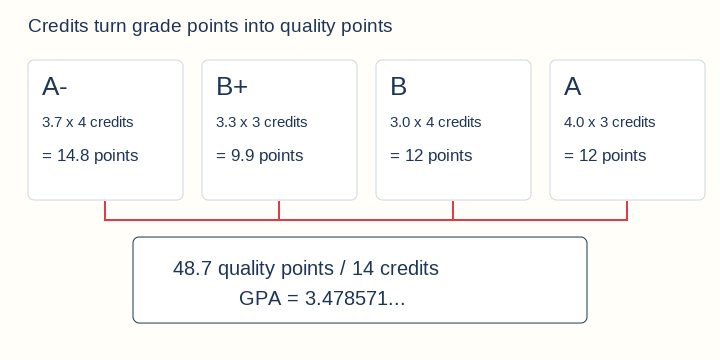
Take four courses: A- worth four credits, B+ worth three, B worth four and A worth three. With grade points 3.7, 3.3, 3.0 and 4.0, quality points are 14.8, 9.9, 12 and 12. The sum is 48.7 and total GPA credits are fourteen. GPA is 48.7/14 = 3.478571…, which this tool displays as 3.48.
With 3.67 and 3.33 for the first two letters, quality points become 14.68 and 9.99. The new sum is 48.67, giving 3.476428… and still displaying as 3.48. The identical rounded result in this example does not mean the conventions are interchangeable: the unrounded totals differ and can matter over many credits or near a threshold.
The University of Illinois registrar provides an institutional example of quality points, GPA hours and truncating rather than rounding its GPA. This tool rounds the visible GPA to two decimals. If you need a transcript match, follow the registrar’s precision and exclusions rather than assuming every calculator should reproduce the same display.
| Course | Credits | Grade points | Quality points |
|---|---|---|---|
| A- | 4 | 3.7 | 14.8 |
| B+ | 3 | 3.3 | 9.9 |
| B | 4 | 3.0 | 12.0 |
| A | 3 | 4.0 | 12.0 |
How do I combine GPAs from different semesters?
Suppose the previous GPA is 3.20 over 45 GPA credits. Its implied quality points are 144. Add this term’s 48.7 quality points and fourteen credits: (144 + 48.7)/(45 + 14) = 3.266101…, displayed as 3.27. Averaging 3.20 and 3.48 would give the new term the same influence as forty-five earlier credits and would not answer the cumulative question.
If the earlier GPA is itself rounded, multiplying it by credits reconstructs only an approximation of earlier quality points. Use the registrar’s actual totals where exactness matters. The calculator accepts previous GPA and credits because they are commonly available, but it cannot recover hidden transcript precision. A target cumulative GPA is also a mathematical scenario, not a forecast of future grades.
Pass, credit and withdrawal marks are excluded in this tool’s GPA tab. Other exclusions may include repeated courses, transfer work or institutional forgiveness rules. Those policies can alter the counted credits as well as the numerator. An excluded course is not the same as an F: an F generally contributes zero quality points while retaining GPA credits, whereas an excluded mark contributes neither here.
How do honors courses affect GPA?
An unweighted GPA uses the same letter-to-points mapping across eligible courses. A weighted high-school GPA may add points for eligible honors or advanced courses, with caps and eligibility rules that vary. The optional A+ value of 4.3 here is a letter-point convention; it is not an automatic honors bonus. Do not select it merely because a course is described as advanced.
For admissions, a college may recalculate a GPA using its own subjects and weights. A local calculator can help you understand arithmetic, but it cannot promise an admissions GPA or academic standing result. Retain your school’s grading table beside the calculation. Use the weighted course guide for percentage totals and the final guide for remaining-score targets; they solve different questions.
Common questions
Is A- always 3.7 grade points?
No. Some scales use 3.67, and other systems differ. Use the published registrar scale.
Does an A+ automatically mean an honors bonus?
No. A+ grade points and honors-course weighting are separate conventions.
Why can my transcript show a different GPA?
Hidden precision, truncation, repeat policies and excluded credits can differ from this calculator’s rounded example.