What do I need on my final? Work out the score
Reading time: 5 min · 5 sections
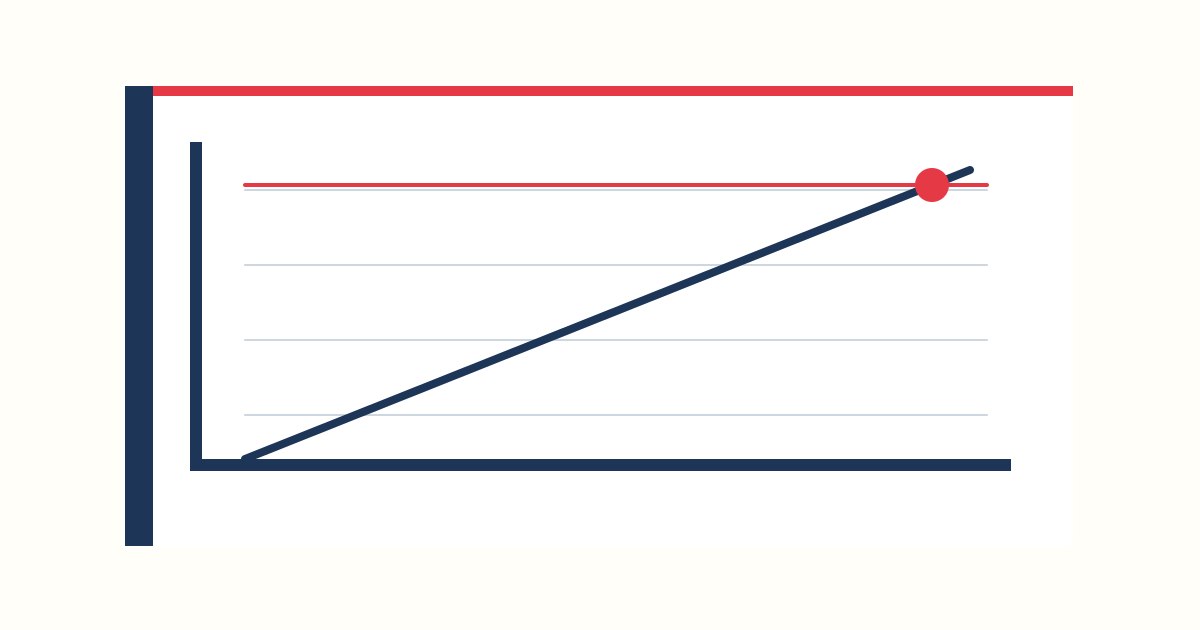
A 90% course goal does not mean you need 90% on the final. Your earlier work has already earned part of that total, and the final can change only its own share.
What numbers do I need to calculate my final score?
I start with the current grade excluding the final, the final’s effective course weight and the target course percentage. Keep those definitions precise. A portal can show a current grade based only on completed work, a projected grade with future assignments treated as zeros, or a running category average. Only the first kind fits the simple formula without adjustment.
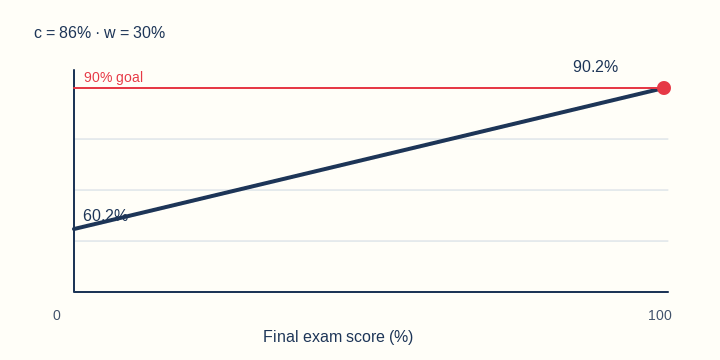
For the working example, suppose your current grade is 86%, the final is 30% of the course, and you want 90%. The completed work therefore contributes 86 × 0.70 = 60.2 course percentage points. The final must supply the remaining 29.8 points. Because it supplies only thirty percent of the course, divide 29.8 by 0.30: you need 99.333333…% on the final.
The RogerHub final grade calculator uses this current-grade, target and weight relationship. You can inspect the same arithmetic in the Final exam tab here, with a graph and a table of targets. Enter the syllabus values first; the defaults deliberately show a demanding example rather than assuming every goal is easy.
How is the required final score calculated?
Let c denote current grade, f final exam score, w final weight as a decimal and g desired course grade. Your completed work has share 1 − w. The course total is c(1 − w) + fw. Setting that equal to g gives fw = g − c(1 − w), then f = [g − c(1 − w)] ÷ w. The percent inputs c, f and g remain on a zero-to-one-hundred scale; only the weight becomes a decimal.
For current 88%, target 80% and weight 25%, the completed contribution is 88 × 0.75 = 66. The remaining fourteen course points require 14 ÷ 0.25 = 56% on the final. Notice that a final below the current grade can still meet a lower course target. A calculator should present that calmly, without interpreting the number as advice about effort.
A useful sensitivity rule falls straight out of the equation: raising the final score by ten percentage points raises the course grade by 10w points. For a 30% final, ten more points on the exam add three course points. For a 10% final, they add only one. The graph is a straight line because this model has a fixed weight and no replacement or dropped-score rule.
| Course target | Final needed at current 86%, weight 30% |
|---|---|
| 93% | 109.34%, beyond 100 |
| 90% | 99.34% |
| 87% | 89.34% |
| 83% | 76.00% |
| 80% | 66.00% |
| 73% | 42.67% |
What if my goal is already secured or impossible?
At a final score of zero, the course grade is c(1 − w). At a final score of one hundred, it is c(1 − w) + 100w. These two bounds tell you whether a goal is already secured or beyond a normal final. For current 100%, final weight 20% and goal 70%, the lowest possible total is 80%. The algebra gives a negative required final, but the practical message is that any nonnegative score meets the target under this model.
For current 70%, goal 90% and a 20% final, the zero-final bound is 56% and the perfect-final bound is 76%. The computed requirement is 170%. There is no need to disguise that as a score of 100 or claim that the target is guaranteed. Extra credit, a course curve or a replacement rule might alter the model, but you cannot assume any of them from the arithmetic alone.
A zero-weight final deserves a separate message because dividing by zero is undefined. Your course total remains the current grade whatever the final score. A final with weight one hundred means the previous work has no influence in this model: the needed final equals the goal. Values outside zero to one hundred for the final weight indicate an input or policy interpretation problem.
How much does a final inside a category count?
Suppose tests are 40% of the course and the final supplies 100 of the 300 possible points in that category. The final’s effective course share is 0.40 × 100/300 = 0.133333…, or 13.3333%. It is not automatically 40%. The rest of the test category supplies the remaining 26.6667% of the course. Combine that completed test work with the other completed categories to get the appropriate current grade excluding the final.
Point totals matter here. If the earlier tests are worth 200 points combined, you cannot infer the final’s share merely by counting it as one of three tests unless all tests have the same possible points. A category average is earned points divided by possible points. Use the weighted grades walkthrough to build the completed course contribution before solving for the final.
A policy that replaces the lowest test is more complicated. The replacement can change the completed contribution as the final score changes, so the outcome can become piecewise rather than one straight line. A dropped assignment can have a similar effect. Ask exactly which test is replaced, whether the final also keeps its own weight, and whether replacement happens only when it improves the grade. Do not insert an arbitrary larger weight to imitate the rule.
How should I round the minimum final score?
Keep the unrounded current grade until the final calculation if your gradebook exposes it. A displayed 86 may hide a number between two rounding boundaries, and a high-stakes cutoff can amplify that difference. The calculator rounds a positive requirement up to the next 0.01%. The exact 99.333333…% threshold is displayed as 99.34%, because 99.33% would leave the course at 89.999%, below the exact target. The arithmetic line retains the ordinary rounded value for comparison.
If the result is 99.34%, a test marked only in whole points may require the next achievable score above the mathematical threshold. On a hundred-point exam that would be 100 points if 99 falls below the target. On a two-hundred-point exam, check the attainable increments separately. The test-grader tab converts points lost into percentages, including partial credit.
Finally, identify the letter cutoff you actually want. In the example plus/minus scale, 90 is A- and 93 is A. A simple ten-point scale may use 90 for A. Whole-percent rounding is a separate school policy. The letter-scale guide distinguishes percentage cutoffs, rounding and GPA points so a reassuring letter does not conceal the wrong target.
Common questions
What if the final replaces another exam?
The simple formula assumes a fixed final weight. A replacement policy changes earlier contributions and may require a piecewise calculation.
Can a target require more than 100%?
Yes. That goal is beyond an ordinary 100% final under the entered weights. Check any announced extra-credit or adjustment rules separately.
Should I round the required 99.34% down to 99 points?
Do not assume so. Use the next attainable exam score that actually meets the mathematical threshold and apply your course’s rounding policy.